
Commercial cooling R&D · hot-humid climates
Reduce the heat load before buying more cooling.
The lowest-energy ton of cooling is the load the building never receives. ICY starts with measured heat, moisture, schedules and air movement; screens passive and control strategies against the actual climate; restores existing-system performance; and adds capacity only for a measured remaining gap.
This is a research and field-screening method—not a savings guarantee, load calculation, engineered design, code determination or authorization for regulated work.
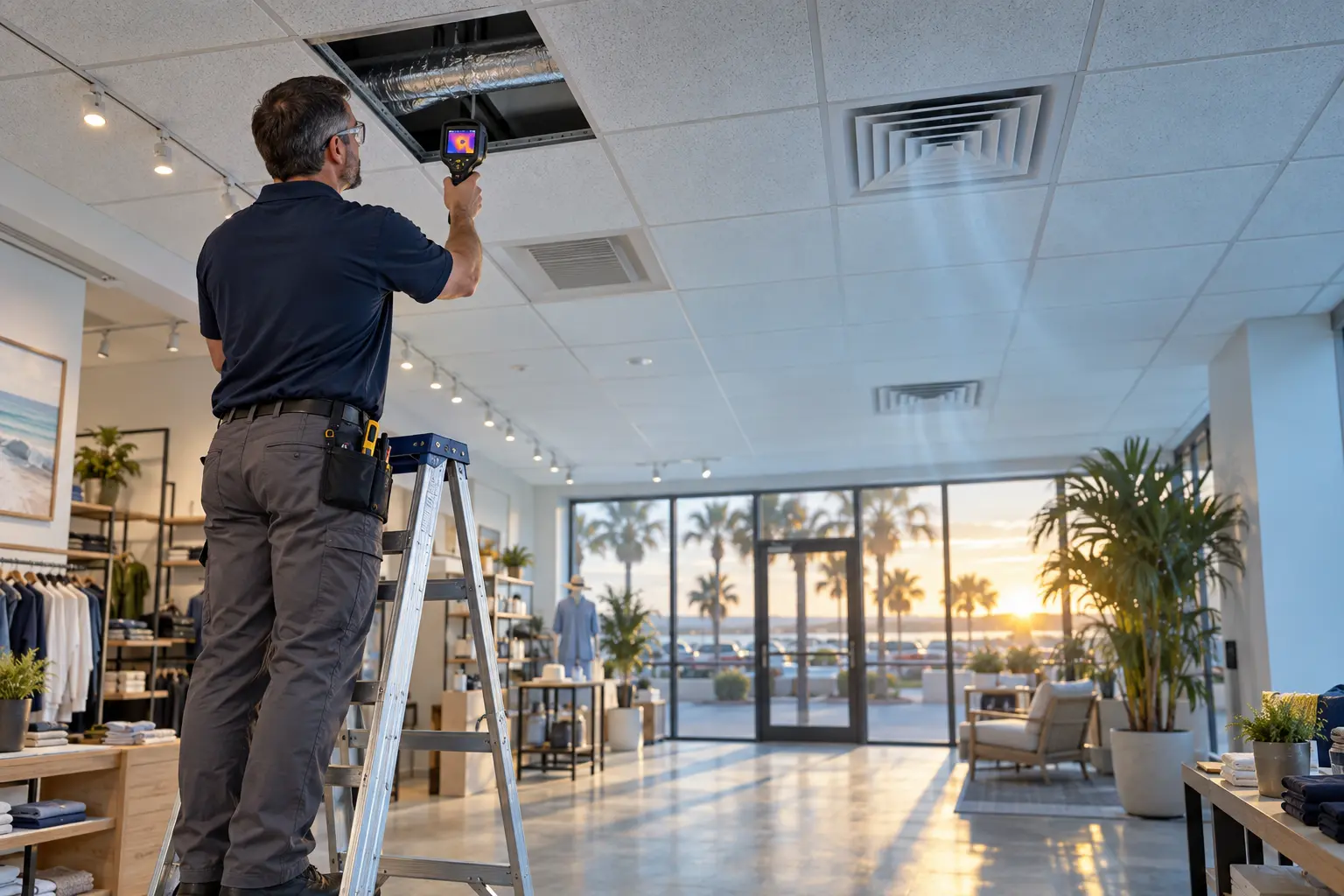
Research-led commercial guide
Published · Updated
Prepared by Gulf Coast Technologies, LLC for ICY AC.
The operating thesis
Reject heat. Delay heat. Move heat. Remove what remains.
Shade and a suitable roof or envelope strategy can keep solar heat out. Schedules and efficient lighting or equipment can cut internal gains. Air movement may improve comfort without lowering air temperature, while controlled outdoor air can sometimes provide cooling. In a Gulf Coast summer, however, outdoor moisture can erase those gains and create condensation risk. Every passive or “free cooling” idea therefore passes a temperature, dew-point, pressure, air-quality, security and control check before it becomes a trial.
The least-wasteful decision ladder
Do not skip from complaint to equipment.
Each rung needs a baseline, a responsible party and a closeout measurement. A promising mechanism is not a site result until the controlled comparison supports it.
- 01Baseline heat, moisture, use and energy
- 02Block avoidable solar and envelope gains
- 03Reduce lighting, plug and process gains
- 04Improve distribution and useful air speed
- 05Control outdoor air, exhaust and humidity
- 06Commission equipment and sequences
- 07Trial storage, timing or mixed-mode operation
- 08Size only the measured residual load
Compare similar weather, occupancy and operating states. Weather normalization and professional analysis may be required before attributing energy savings.
Hot-humid screening matrix
Twelve strategies—and the check each must pass.
The first question is not “does this technology work?” It is “what mechanism matters here, under which conditions, and what evidence will close the trial?”
Exterior shade
Check: orientation and hourly surface/zone pattern. Mechanism: stop sun before glass or wall absorbs it. Risk: wind, egress, daylight and attachment. Accept: comparable surface, zone and cooling-load response.
Cool roof + insulation
Check: roof assembly, climate, drainage and condition. Mechanism: reflect and slow roof heat. Risk: moisture, glare, heating tradeoff and incompatible coating. Accept: roof/ceiling heat-flow and runtime comparison.
Air sealing
Check: pressure and leakage-path evidence. Mechanism: limit uncontrolled hot, humid air. Risk: disturbing required ventilation or combustion safety. Accept: scoped leakage/pressure and indoor-dew-point improvement.
Glazing treatment
Check: exact glass, film compatibility, orientation and visual needs. Mechanism: reduce solar transmission. Risk: seal/glass damage, warranty and winter/daylight penalties. Accept: measured glass/zone load under comparable sun.
Lighting + plug loads
Check: circuit, schedule and operational inventory. Mechanism: remove internal watts that become heat. Risk: disabling essential or safety equipment. Accept: verified schedule/kW reduction with maintained function.
Kitchen/process coordination
Check: hood/process use and pressure map. Mechanism: capture heat at source and balance replacement air. Risk: fire, code, combustion and IAQ consequences. Accept: qualified scope plus measured pressure, capture and zone result.
Fans + destratification
Check: occupancy, ceiling geometry and temperature gradient. Mechanism: improve useful air speed and distribution. Risk: drafts, noise or mixing hotter/contaminated upper air downward. Accept: occupied comfort and mapped temperature/air-speed change.
Economizer or night purge
Check: outdoor enthalpy/dew point, smoke/pollution, security and controls. Mechanism: use favorable outdoor air instead of compressor cooling. Risk: latent load and condensation. Accept: logged damper state, indoor dew point and reduced mechanical cooling.
Demand-controlled ventilation
Check: occupancy/use, code, sensors and minimum ventilation. Mechanism: avoid conditioning excess outdoor air when lawful and suitable. Risk: poor IAQ from bad assumptions or sensors. Accept: commissioned sequence and ventilation/IAQ evidence.
Energy recovery
Check: airflow, contamination, climate and pressure needs. Mechanism: transfer sensible and, where designed, latent energy between air streams. Risk: cross-leakage, frost, maintenance and fan energy. Accept: measured air states, pressure and net-energy result.
Controls + variable speed
Check: sequence, sensors, equipment capability and trend data. Mechanism: match fan, pump and compressor output to load. Risk: unstable control, inadequate ventilation or hidden overrides. Accept: commissioned trends and occupied performance.
Thermal storage or pre-cooling
Check: thermal mass, tariff, weather and moisture model. Mechanism: shift load into a favorable time window. Risk: condensation, rebound peak or comfort failure. Accept: controlled trial with temperature, dew point, demand and comfort logs.
Envelope, controls, mechanical, electrical, fire/life-safety and engineering responsibility belongs to the qualified discipline required for the exact change. ICY can build the shared evidence and acceptance record.
A research loop that can survive scrutiny
Screen. Instrument. Trial. Recheck.
A field experiment changes one bounded condition where possible and preserves the context needed to interpret it.
Define the question.
Name the load or comfort mechanism, the competing explanations and the decision the result will change.
Set the baseline.
Record representative outdoor and indoor dry-bulb temperature, relative humidity or dew point, the coldest relevant surface, indoor-outdoor pressure under named equipment, door and hood states, occupied air speed and direction, occupancy evidence, ventilation and exhaust state, control schedules, and separately metered cooling demand where qualified and safe.
Pass the safety checks.
Confirm authority, code, IAQ, moisture, electrical, structural, fire, security and manufacturer constraints.
Run a reversible pilot.
Prefer a bounded shade, schedule, control or airflow change before an irreversible capital project when the scope permits.
Compare honestly.
Use comparable operating periods or an appropriate normalized analysis; preserve failed and ambiguous trials too.
Scale only the result.
Write the mechanism, limits, responsible party, maintenance requirement and acceptance test into the permanent scope.
Choose intervals that can capture equipment cycles, door and hood events, and schedule transitions; a daily or weekly spot reading is not a complete reversible pilot. Measuring ventilation rates in hot-humid climates means evaluating airflow, outdoor and indoor moisture, pressure, exhaust, occupancy, controls and adopted minimums together.
Climate-specific efficient equipment
DOE notes that sensible and moisture-removal needs vary with climate and that economizers require favorable outdoor temperature and humidity.
DOE light-commercial HVAC guidance →Retrofit and commissioning
DOE identifies economizers, energy recovery, demand control, automation and commissioning as building-specific efficiency paths whose controls and operation must be verified.
DOE HVAC retrofit guidance →Passive cooling mechanisms
NREL describes shading, thermal mass and natural ventilation as passive cooling tools. Their usefulness still depends on climate and the actual building.
NREL passive-solar basics →Moisture must stay controlled
EPA connects humidity control with ventilation, exhaust, pressurization, condensate, envelope and dehumidification design.
EPA moisture-control guidance →What ICY will not promise from a web page
No universal percentage, automatic “free cooling,” square-footage-only equipment size or single-product answer. Savings, comfort, humidity, durability and payback depend on the site baseline, climate, operation, installed scope and verified result.
Cooling demand · comfort · humidity · controls
Build the evidence before the capital request.
Send the site, use, complaint, utility history if available, equipment labels, schedules and known building changes. ICY will define the first useful baseline and the lowest-risk trial.